
Cafe Furniture Solutions That Work Hard

Updated: May 26

A busy café rarely fails because the coffee is weak. More often, the room itself starts working against the business. Tables are too large for the floorplate, chairs become unstable after a few months, aisle spacing slows service, and the overall look feels less considered than the menu. Good café furniture solutions address those issues early, before they become operational costs.
For café operators, furniture is not simply a purchasing line. It affects covers, customer flow, cleaning time, staff movement, brand perception and maintenance spend. That is why the right approach is not to choose items in isolation, but to specify furniture as part of a complete operating environment.
What café furniture solutions should solve
The best furniture decisions solve commercial problems first.
A chair must be comfortable, but it also needs to stack or move easily if the space is reconfigured.
A tabletop must support the brand aesthetic, but it also needs to resist staining, heat and constant wiping.
Banquette seating can improve capacity, though it may reduce flexibility if the layout needs to change later.
This is where many projects become unnecessarily expensive. Buyers compare products piece by piece rather than asking how each selection performs across the whole venue. In cafés, margins are tight and wear is constant. Furniture has to earn its place through durability, layout efficiency and ease of upkeep, not only visual appeal.
For single-site operators, this means choosing pieces that support a smooth launch and predictable maintenance. For groups and chains, it means creating a specification that can be repeated across locations without losing consistency or slowing down roll-out.
Layout first, product second

One of the most common mistakes in café fit-outs is selecting furniture before the floor plan is properly resolved. A product may look right in a catalogue and still be wrong for the room. Seat width, table base footprint, chair pull-out space and server circulation all affect whether the venue feels calm or crowded.
Furniture planning should begin with the intended service model. A quick-service café has different needs from an all-day brunch venue. If dwell time is short, smaller tables, efficient seating turnover and clear queue movement matter more. If the concept encourages longer stays, comfort and acoustic softness become more important, even if this slightly reduces density.
Window seating, communal tables and compact two-tops each serve different purposes.
The right balance depends on customer profile, average party size and peak trading pattern.
It is rarely a case of fitting the maximum number of seats.
Overcrowding can hurt service speed and reduce customer comfort, which ultimately affects repeat visits.
The trade-off between capacity and comfort
More seats do not always mean better revenue. In many cafés, adding extra tables creates congestion at exactly the times when staff need clear movement. If customers feel squeezed, they may leave faster than planned, but not in a way that improves turnover. They simply choose another venue next time.
A more effective strategy is to build a layout that supports natural circulation while preserving enough flexibility for quieter and busier periods. That may mean mixing fixed seating with loose furniture, or using smaller tables that can join together when needed.
Materials matter more than trends

Café furniture takes a different kind of punishment from residential furniture. It is dragged, wiped, bumped, stacked, exposed to spills and cleaned repeatedly. Materials must therefore be chosen for commercial life, not showroom appearance.
Timber finishes add warmth, but not all timber constructions perform equally in high-traffic environments. Metal frames can offer long-term strength, though finish quality is critical in humid or spill-prone conditions. Laminate and compact surfaces are practical for tabletops where easy cleaning is a priority, while upholstered seating can improve comfort and soften the room if the fabric or vinyl is suitable for hospitality use.
Outdoor areas require even tighter specification. Sun exposure, rain, corrosion risk and storage all need consideration. A chair that works well indoors may fade, warp or deteriorate quickly on a terrace. Choosing separately for indoor and outdoor zones is often the more cost-effective route, even when visual continuity is required.
Durability is only useful if maintenance is manageable
Some products last well structurally but become operationally difficult because they show marks too easily or need frequent repair. The real test is how furniture performs after months of service. Can surfaces be cleaned quickly? Are replacement parts available? Can damaged upholstery be repaired without replacing the full unit? These questions affect cost of ownership as much as the purchase price.
Consistency across concept and brand
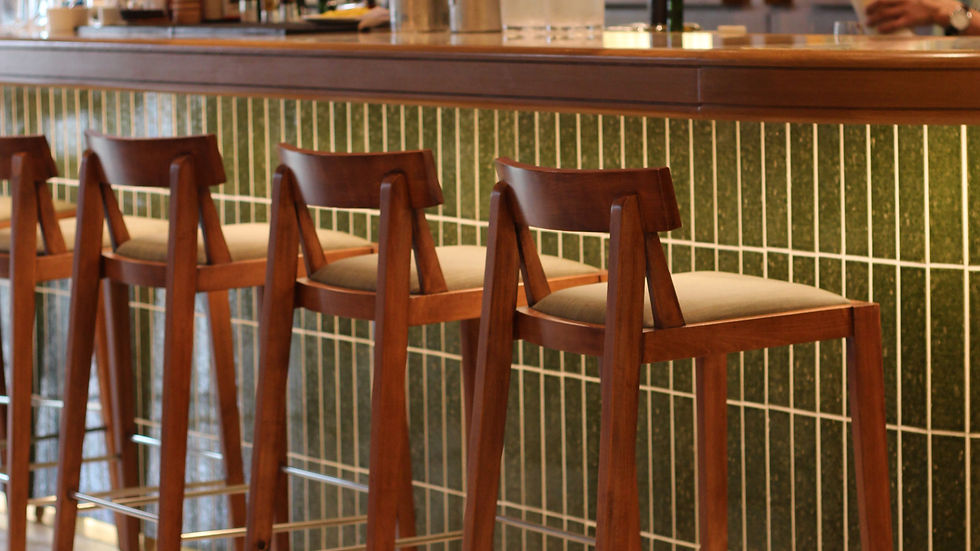
Café furniture solutions should support the concept, not compete with it. A modern minimalist café, a premium dessert brand and a fast-moving kiosk each need a different furniture language. The wrong specification can create visual confusion, even if the individual pieces are attractive.
For independent operators, consistency builds identity. Customers may not notice every chair or base detail, but they recognise when the space feels coherent. For multi-outlet businesses, consistency becomes even more important. Repeating core furniture standards across sites helps maintain brand recognition, simplify procurement and reduce decision delays.
That does not mean every outlet must look identical. Site conditions vary, and local demographics may influence seating mix or finish choice. The goal is controlled flexibility - a clear family of approved solutions that can adapt without compromising brand standards.
Why procurement by item often creates problems
Buying tables from one supplier, chairs from another and banquettes from a separate contractor can appear cost-conscious at the start. In practice, it often creates delays, mismatched lead times and inconsistent quality control. Responsibility becomes fragmented. If dimensions clash or finishes do not align, the operator absorbs the disruption.
A total-solutions approach reduces that risk. Professional advice at the specification stage helps align furniture with design intent, service needs and budget realities before orders are placed. Project coordination then becomes simpler because one specialist partner manages compatibility, scheduling and practical execution.
This matters most when timelines are tight. Café openings and refurbishments usually work to fixed launch dates, lease obligations and staffing plans. Missed delivery windows have wider operational consequences than most buyers would like.
Café furniture solutions for scaling operators
The needs of a first-time café owner and a multi-unit group are not identical, but both benefit from structured specification. For a new operator, support is often needed in translating a concept into furniture types, finishes and quantities. For a growing group, the challenge is usually standardisation without making every venue feel generic.
This is where a hospitality-focused partner adds practical value. Instead of simply supplying products, the right provider helps define seating ratios, recommend materials suited to the concept, coordinate accessories and maintain continuity between design and rollout. BAREKA by Kian operates in that space, supporting F&B businesses with furniture supply, design consultation and implementation support under one commercial framework.
For chain operators, this also improves future maintenance. Approved specifications make it easier to reorder, replace damaged pieces and preserve consistency during renovations or expansion.
Making better decisions before approval
Before signing off any furniture package, decision-makers should pressure-test the specification against actual service conditions.
How long are customers expected to stay?
How quickly must tables turn?
Will staff move furniture daily?
Is storage needed for spare seating?
How often is the venue likely to refresh its look?
Budget should also be judged over the operating cycle, not only at purchase. A lower-cost chair that fails in a year is rarely better value than a stronger model with a longer service life. Equally, overspecifying premium materials for a fast-turnover café may not produce a return. The right answer depends on concept, volume and site conditions.
Strong café environments are built on practical decisions that still leave room for personality. When furniture is planned as part of the business model rather than treated as a final decorative layer, operators gain something more useful than a good first impression. They gain a venue that is easier to run, easier to maintain and better prepared for the pace of daily trade.
The smartest furniture choice is usually the one customers barely notice, because everything in the room simply works.


Comments