
Choosing a Quick Service Furniture Supplier

Updated: Sep 2
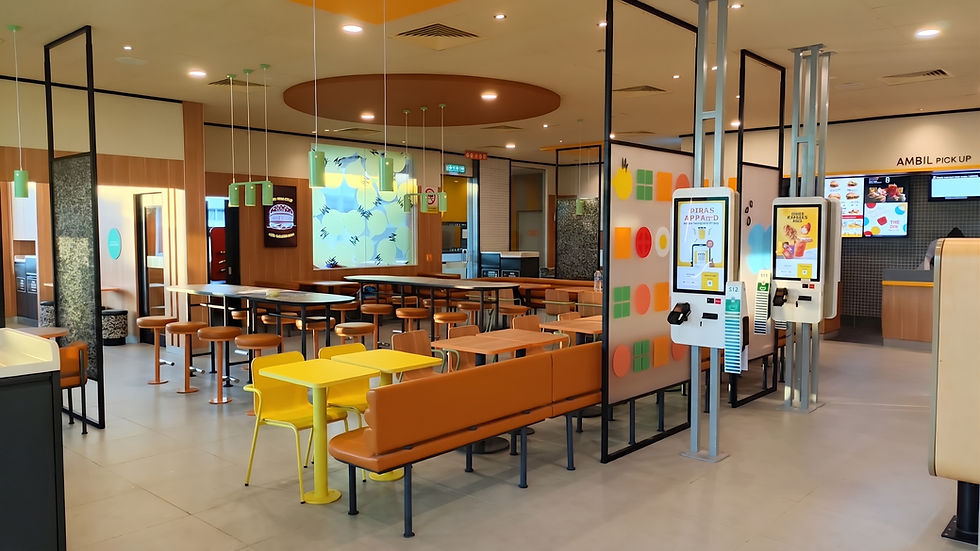
A delayed opening rarely comes down to one dramatic failure. More often, it is a string of small misses:
The wrong lead time
Inconsistent chair finishes
A counter stool that does not suit turnover
A supplier who can deliver products but not practical answers
That is why selecting the right quick service furniture supplier matters far beyond tables and chairs. For quick-service restaurants, cafés and food court operators, furniture decisions affect speed to launch, brand consistency, customer flow and maintenance costs from day one.
In the quick-service segment, furniture has a different job from furniture in a fine dining venue or boutique lounge. It must support high footfall, fast cleaning, efficient layouts and repeatable rollouts. It also needs to fit a commercial concept, not just look acceptable in a showroom. A capable supplier understands that the brief is operational as much as visual.
What a Quick Service Furniture Supplier Should Actually Deliver
A reliable quick service furniture supplier is not simply a catalogue with stock availability. At a commercial level, the role is broader. The supplier should help translate a brand concept into practical furniture specifications that work across service conditions, outlet formats and budgets.
That usually starts with understanding the venue type. A high-street takeaway with limited dine-in seating has different priorities from a mall-based QSR, a café kiosk or a food court cluster:
Seat count
Table turnover
Cleaning routines
Space constraints
Customer dwell time
All of these influence the right furniture mix. If those details are not discussed early, operators often end up replacing items sooner than planned or compromising the layout after installation.
A strong supplier also supports standardisation. This is especially important for chains and multi-site operators. Consistent finishes, dimensions and design language create a recognisable customer experience and simplify future procurement. Standardisation, however, should not mean rigidity. Some sites need minor adjustments due to footprint, landlord requirements or customer demographics. The right partner can keep the brand consistent while adapting the specification where necessary.
Speed Matters, But So Does Fit-for-Purpose Planning
Quick-service operators often place speed at the top of the brief, and understandably so. Delays mean missed revenue, contractor disruption and pressure across the opening schedule. Even so, speed without planning can be expensive. Fast delivery of unsuitable furniture is not a win.
This is where an experienced quick service furniture supplier adds value. Instead of treating procurement as a late-stage purchase, the supplier should be involved early enough to flag practical issues:
Table bases may affect circulation
Banquette depths may reduce capacity
Outdoor selections may require different materials than first assumed
Bar-height seating may look efficient on plan but perform poorly for family-heavy traffic
The trade-off is usually between lead time, budget and customisation. Off-the-shelf ranges can reduce time to site, but they may offer less control over finish and branding. Bespoke items can support a stronger concept and better fit, but they need more coordination and production time. In many projects, a mixed strategy works best — standard products where speed and consistency matter most, paired with custom elements in focal areas.
Durability Is More Specific Than Many Buyers Expect
Commercial buyers already know durability matters, but the detail often gets underestimated. Not all commercial-grade furniture is equal, and quick-service environments are particularly demanding. Constant movement, frequent cleaning, spills, stacking, drag loads and high daily turnover place stress on every surface and joint.
Material choice should reflect actual use, not generic claims. Compact laminate, metal frames, moulded components and performance upholstery may all have a place, depending on the concept. The best selection depends on:
Cleaning chemicals
Indoor or semi-outdoor placement
Air conditioning levels
The expected user profile
A busy family-oriented outlet may need a different specification from an office district coffee concept, even if both operate under quick-service conditions.
Maintenance should be part of the conversation from the start. Some finishes are attractive at handover but difficult to maintain once the site is trading at full pace. Others are easier to repair, refinish or replace in sections. Over the life of a venue, that difference can be commercially significant.
Why One Supplier Is Often Better Than Several

Fragmented sourcing can look cost-effective at first. One vendor for chairs, another for tables, a separate contractor for banquettes and a different party for accessories may appear to offer flexibility. In practice, it often creates coordination risk.
When timelines tighten, multiple vendors mean multiple production schedules, multiple quality thresholds and multiple points of failure. If dimensions clash or finishes do not align, the operator is left managing the gap. For opening teams already handling equipment, staffing and compliance, that is not a good use of time.
A total-solutions supplier reduces that complexity. Professional advice, furniture selection, concept input, specification control, delivery coordination and after-sales support sit under one accountable structure. That does not remove every project risk, but it makes issues easier to manage and responsibilities much clearer. For growing brands, it also creates a stronger platform for repeat rollouts.
Questions Worth Asking Before You Appoint a Supplier
The right decision usually becomes clearer when buyers move beyond product questions and test delivery capability:
How does the supplier manage lead times across standard and custom items?
What support is provided during planning, not just at order stage?
How do they handle multi-site consistency, replacement orders and post-installation issues?
It is also worth asking about sector experience. Hospitality furniture is not the same as office furniture repurposed for dining use. A supplier with genuine F&B experience will usually speak in operational terms — covers, dwell time, cleaning cycles, zoning, circulation and wear points — rather than only discussing finishes and styles.
Project support is another useful test. Some suppliers are strong at product supply but weak at implementation. Others can support design coordination, accessories, layout logic and site scheduling in a more integrated way. If your business is opening, refurbishing or scaling at pace, that difference matters.
The Rollout Challenge for Growing Brands
Single-site operators and multi-unit groups face different pressures, but furniture planning becomes more complex as the estate grows. One successful pilot store can hide specification gaps that become expensive across ten or twenty locations. Small inconsistencies in seat height, tabletop finish or joinery detailing multiply quickly when ordered at scale.
For expansion projects, repeatability should be built into the furniture strategy. That includes:
Approved ranges
Finish libraries
Application rules
Replacement planning
It also helps to have a supplier who can advise on where variation is acceptable and where strict standardisation protects the brand.
This is particularly relevant in Malaysia's mixed property landscape, where shopping centres, roadside units, transport-linked sites and public-space food areas all bring different constraints. A dependable partner should be able to maintain the core concept while accounting for real site conditions.
Furniture Should Support the Business Model

It is easy to treat furniture as a finishing layer once the kitchen, equipment and brand assets are decided. In reality, it affects how the business performs:
Seat layout influences throughput
Material selection affects cleaning labour
Banquette design changes capacity
Outdoor furniture can create extra revenue opportunities, or extra maintenance headaches, depending on the specification
That is why the best supplier relationships are consultative rather than transactional. A commercially focused partner will not simply ask what style you want. They will ask how the outlet trades, who the customers are, how quickly tables turn, whether refurbishment cycles are tight and what matters most — speed, durability, design impact or rollout consistency. The answer is rarely just one of these.
For operators who want fewer moving parts, this is where a specialist provider such as BAREKA by KIAN can make a measurable difference. A total furniture solutions model gives decision-makers one point of contact for advice, specification, supply and project coordination, which is often the difference between a controlled rollout and a reactive one.
Choosing a quick service furniture supplier is ultimately a business decision, not a styling exercise. The right partner helps you open on time, trade with confidence and maintain standards as the business evolves. If the supplier can reduce complexity while protecting durability and brand consistency, that is not an added extra — it is part of running a better hospitality operation.


Comments