
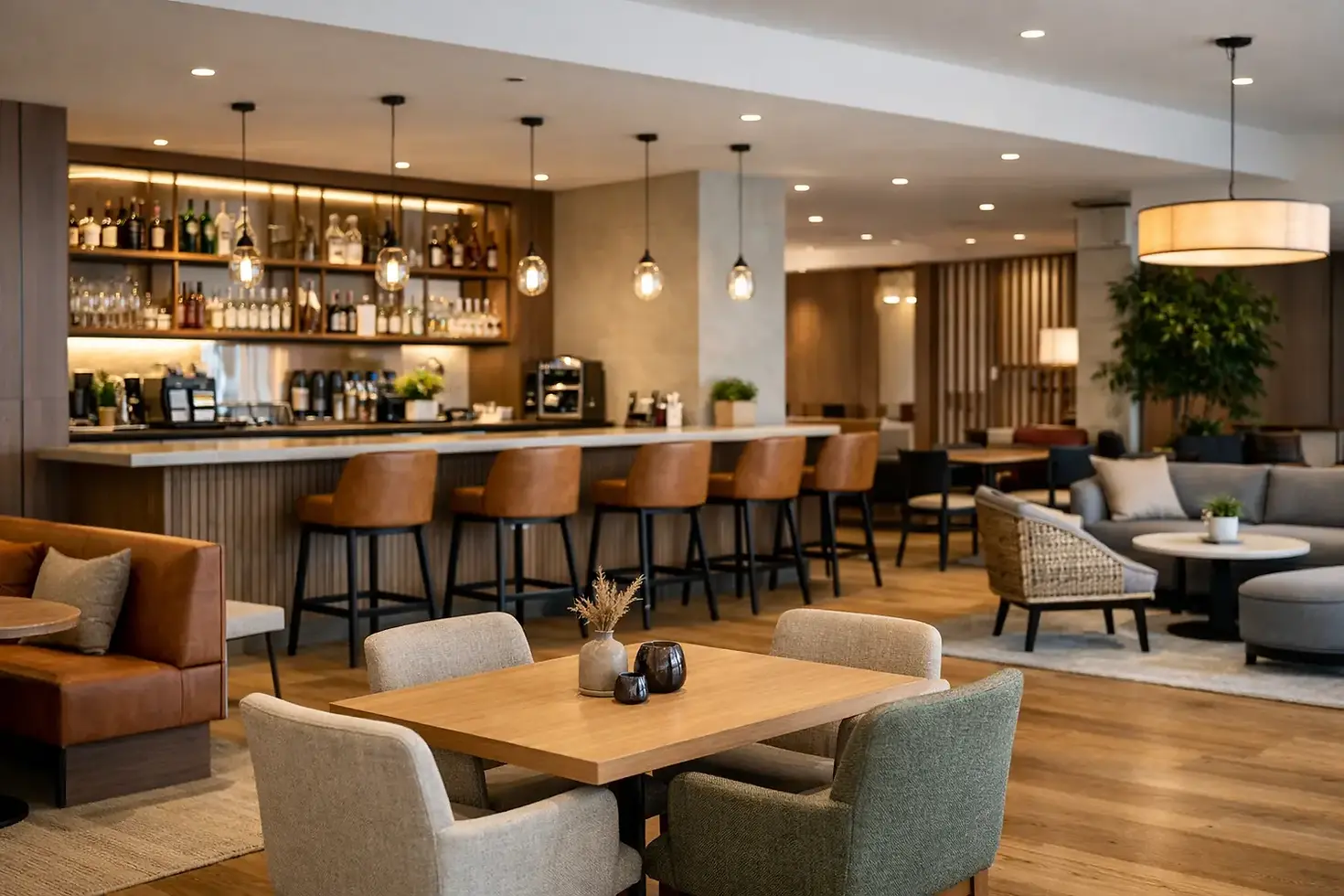
Hospitality Fit Out That Works Harder
- BAREKA Malaysia

- 9 hours ago
- 5 min read
A busy lunch service exposes every weakness in a space. Chairs scrape, table tops take knocks, queues form in the wrong place, and staff lose seconds at every turn. That is why a hospitality fit out cannot be treated as a styling exercise. For restaurants, cafés, bars, food courts and quick-service brands, the fit-out has to perform under pressure from day one.
The best venues look considered because they have been planned around operations, not in spite of them. Layout, furniture specification, finishes, circulation and maintenance all affect trading performance. If the space is attractive but difficult to run, the cost shows up quickly in slower service, higher repair rates and inconsistent customer experience.
What a hospitality fit out really needs to achieve
At commercial level, a fit-out has three jobs. It needs to support the brand, it needs to help the team work efficiently, and it needs to stand up to daily use. Many projects lean too heavily into one of these and create problems elsewhere.
A design-led venue may photograph well but struggle with capacity, storage or table turnover. A purely cost-led scheme may open on budget but feel generic, age badly and require replacement sooner than expected. A strong hospitality fit out balances appearance with commercial function.
This matters even more in food and beverage environments because wear is constant and service is fast. Guests judge comfort, cleanliness and atmosphere within minutes. Staff notice bottlenecks immediately. Operators feel the impact in labour efficiency, maintenance costs and repeat business.
Start with service flow, not furniture selection
Furniture is highly visible, but it should not be the first decision. The first priority is understanding how the venue needs to operate. That means looking at customer journey, ordering points, waiting areas, circulation, service stations, delivery access and cleaning routines.
For a café, this may mean protecting takeaway flow so it does not interfere with dine-in seating. For a full-service restaurant, it may mean allowing clear routes between kitchen pass, waiter stations and table zones. For a QSR brand, it often means designing around queue management, self-ordering points and fast table reset.
This is where many fit-out programmes either save time or lose it. When concept, furniture planning and execution are handled in isolation, decisions clash. A banquette may improve capacity but reduce access for cleaning. A communal table may suit the look of the venue but compromise flexibility during quieter trading periods. The right answer depends on the operating model.
Hospitality fit out decisions that affect profit
Operators usually see fit-out spend as capital expenditure, which it is. But the more useful view is to see it as an operating decision as well. A poor specification creates recurring cost. A good one reduces friction over the life of the site.
Seating comfort influences dwell time, which is positive in some formats and unhelpful in others. Fine dining and premium casual concepts may want guests to stay longer. High-volume cafés and food courts may need balanced comfort that supports turnover without feeling harsh. There is no universal rule. The venue type, price point and service model should shape the furniture brief.
Durability is another area where cheap choices often become expensive ones. Commercial-grade chairs, table bases and finishes are built for repeated use, cleaning and movement. Domestic-style products can look acceptable at opening, but under hospitality conditions they fail faster. Wobbling tables, chipped surfaces and unstable seating undermine trust in the whole venue.
Maintenance should also be part of the early conversation. Upholstery selection, edge detailing, replaceable components and spare planning can all make a difference once the site is trading. If a venue group is scaling across multiple locations, standardisation becomes even more important. Consistent specifications simplify procurement, speed up replacement and protect brand presentation.
Design consistency matters more when you scale
Independent operators and multi-site brands face different pressures, but both need consistency between concept and execution. For single-site businesses, the challenge is usually opening on time without managing too many suppliers. For groups, the challenge is replicating standards across locations while adapting to different footprints.
A hospitality fit out for one flagship site can tolerate more bespoke detailing if the budget allows. A rollout programme needs stronger discipline. Materials, furniture dimensions, finishes and accessories have to be selected with repeatability in mind. If every branch requires different sourcing, different tolerances and different installation solutions, timelines and costs quickly drift.
This is where a total-solutions approach has practical value. Instead of splitting concept advice, furniture procurement, accessories and project coordination across several parties, operators can reduce risk by working with a specialist partner who understands F&B environments from planning through to after-sales support. For many brands, that simplicity is not just convenient. It protects opening dates and operational confidence.
The most common fit-out mistakes
The first is overestimating covers. On paper, adding more seats can improve revenue potential. In practice, overcrowding creates poor circulation, slower service and an uncomfortable guest experience. The result is often lower performance, not higher.
The second is underestimating storage and back-of-house support. Front-of-house gets attention because it is visible, but staff efficiency depends on what guests do not see. If service tools, cleaning supplies or spare furniture have nowhere sensible to go, the whole venue feels less controlled.
The third is specifying on appearance alone. Timber tone, fabric colour and profile matter, but so do weight, stability, cleanability and lead time. In hospitality, products are used hard. The specification must reflect that reality.
The fourth is leaving furniture planning too late. Once layouts are fixed without proper furniture coordination, operators can end up compromising both capacity and comfort. Early planning avoids expensive adjustments near completion.
How to judge whether your fit-out plan is commercially sound
A good test is to walk through the venue as three different people: a customer, a server and an operations manager. The customer needs clarity, comfort and a space that feels intentional. The server needs efficient routes, sensible spacing and furniture that is easy to reset. The operations manager needs durability, maintainability and confidence that the site can trade consistently.
If one of those perspectives is ignored, problems usually appear soon after opening. Beautiful spaces can still be difficult to run. Efficient spaces can still feel forgettable. The strongest projects are not the ones that spend the most. They are the ones where every major decision supports the business model.
Another useful check is lifecycle thinking. Ask what the venue will look like after six months, not just on launch day. Will surfaces still present well? Can high-use items be repaired or replaced efficiently? Will future branches be able to match the same scheme without delay? These are commercial questions, not cosmetic ones.
Why specialist support changes the outcome
Hospitality projects often fail at handover points. Design intent is one handover. Procurement is another. Installation and snagging add more risk. The more fragmented the supply chain, the more likely details slip between teams.
Specialist support reduces that fragmentation. It gives operators clearer accountability, more practical specification advice and better coordination between concept and execution. For hospitality businesses working to tight launch dates, that can be the difference between a controlled opening and a disruptive one.
This is particularly relevant in Malaysia’s F&B market, where operators may be launching a new concept, refurbishing a tired venue or rolling out multiple branches with limited internal resources. A partner such as BAREKA by Kian can support that process with professional advice, furniture solutions, project coordination and ongoing maintenance planning under one structure. That kind of support is valuable because it addresses the full operating picture, not just the purchase order.
A fit-out should make trading easier
The best hospitality spaces do more than look right. They reduce friction. They help staff serve confidently, help guests feel comfortable, and help owners protect their investment over time.
If you are planning a hospitality fit out, the right question is not simply what the venue should look like. Ask how it needs to work at 8 am, at peak lunch, during a rainy evening, and six months after opening. The answers usually lead to better decisions and a venue that performs as well as it presents.


Comments