
Restaurant Fit-out Case Study That Actually Matters


A restaurant can look impressive at handover and still fail the operator three weeks after opening. Chairs scrape too loudly, banquettes wear early, tables are sized badly for service flow, and the waiting area blocks takeaway traffic at peak hours. That is why a restaurant fit-out case study is only useful when it goes beyond finishes and mood boards and looks at operational reality.
For owners, procurement teams and project leads, the real question is not whether a venue photographed well on day one. It is whether the fit-out supported revenue, staffing efficiency, maintenance control and repeatability. In hospitality, every design choice becomes an operational decision once the doors open.
What a restaurant fit-out case study should measure
A strong case study should show how the space performed against commercial goals. That starts with the brief. Was the venue designed for fast table turns, longer dwell time, high-volume takeaway, or a mixed-service model? Without that context, even attractive project results tell you very little.
The next layer is furniture planning. In many projects, furniture is treated as a late-stage procurement item. That usually creates avoidable pressure. Seat counts become compromised, lead times tighten, and operators end up choosing from what is available rather than what is suitable. In a hospitality environment, that affects durability, cleaning routines, guest comfort and brand consistency.
A useful case study should also examine coordination. Fit-out projects rarely fail because of one dramatic mistake. More often, they lose time and money through fragmented decision-making. Designers, contractors, operations teams and furniture suppliers work in parallel rather than in sequence. The result is rework, rushed approvals and compromises that could have been prevented much earlier.
Restaurant fit-out case study - a realistic project scenario
Consider a casual dining concept preparing to open its second and third outlets in Malaysia. The brand had a clear food offer and a reasonably defined visual identity, but the first site had exposed several issues. Seating ratios were inconsistent, imported furniture had caused delivery uncertainty, and maintenance requests began almost immediately because surfaces were not suited to daily cleaning practices.
For the next phase, the operator set a different objective. The target was not simply to reproduce the first outlet. It was to standardise a workable format that could be rolled out with fewer delays and less variation from one site to the next.
The project team began with operational mapping rather than aesthetic selection. Front-of-house zones were reviewed according to traffic, service touchpoints and customer mix.
A quick lunch crowd needed efficient two-top and four-top arrangements.
Evening trade required a more comfortable perimeter seating strategy.
Takeaway collection needed to sit outside the main dine-in flow so staff could manage both channels without congestion.
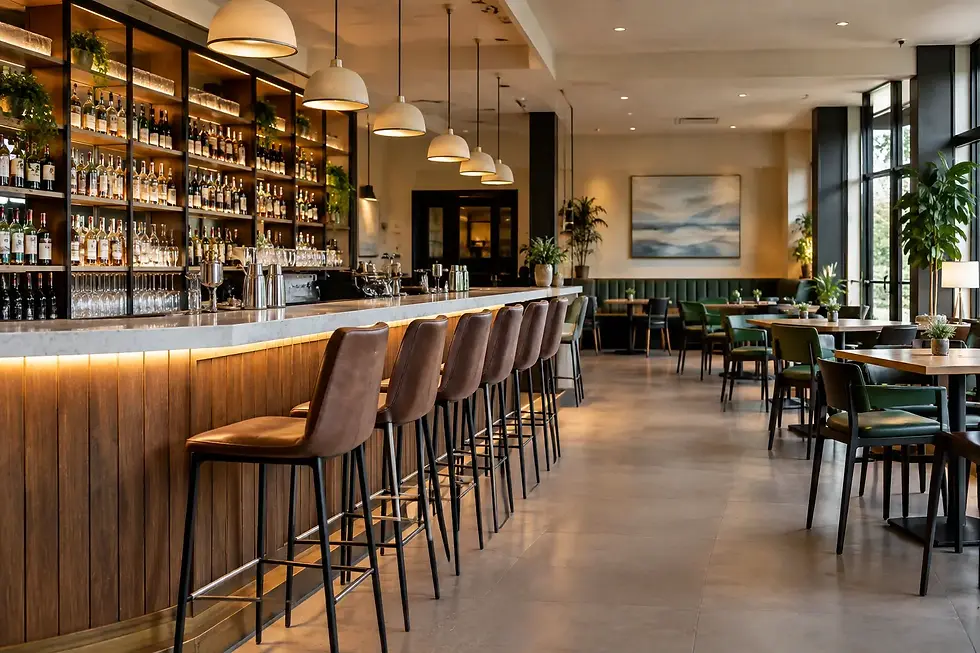
That early planning changed the furniture conversation. Instead of choosing products room by room, the team specified according to function. High-turn seating in the main dining area prioritised durability, easy handling and simple maintenance. Banquettes were used where seat density mattered, but dimensions were controlled carefully to avoid overbuilding and reducing table flexibility. Bar stools were selected not only for style but also for footrest strength, stackability where relevant and ease of replacement across outlets.
This is where specialist support tends to make the biggest difference. Hospitality operators do not just need products. They need decisions to be made in the right order, with enough technical understanding to prevent downstream problems.
Where the project gained time and control

One of the most valuable changes in this scenario was bringing furniture specification into the fit-out process earlier. That allowed the operator to resolve finishes, materials and quantities before construction reached its final stages. It also reduced the risk of mismatch between fixed joinery and loose furniture.
For example, table bases were selected alongside flooring and circulation planning, not afterwards. That meant spacing could be verified properly and service routes could be tested against actual footprint requirements. In many restaurants, lost efficiency comes from small layout errors that are obvious only once staff start moving trays, clearing tables and managing queues.
Material decisions were also made with lifecycle cost in mind. The cheapest option rarely remains the cheapest once cleaning frequency, replacement cycles and visible wear are considered. Timber-look finishes may suit the concept, but edge performance, scratch resistance and moisture tolerance matter just as much in day-to-day operation. Upholstery may elevate the customer experience, yet if it stains easily or slows turnover during cleaning, it creates a hidden cost.
The operator also benefited from consolidating supply and project support. Instead of managing separate parties for furniture sourcing, design refinement, accessories and after-sales issues, the team worked through a more coordinated delivery model. That reduced approval loops and gave management clearer accountability. For multi-outlet businesses, that kind of structure is often the difference between a rollout plan and a series of one-off projects.
The trade-offs that a good case study does not hide
No serious restaurant fit-out case study should pretend every decision is straightforward. There are always trade-offs, and they depend on the concept.
Higher seat density can improve revenue potential, but it can also reduce comfort and damage the brand experience if circulation becomes tight.
Premium materials can strengthen perception, but they may not be justified in a fast-service environment where simplicity and replacement speed are more valuable.
Custom-made furniture can create a distinct identity, yet too much customisation may slow future rollout or complicate maintenance.
Lead time is another common pressure point. Operators often want flexibility late in the programme, especially when menu strategy or service style is still being refined. But every late change has a cost. A dependable fit-out plan balances room for adjustment with enough early discipline to protect procurement, production and installation milestones.
This is particularly relevant for chains and growing groups. Standardisation sounds simple, but it should never mean forcing identical solutions into very different sites. Ceiling heights, frontage conditions, mall requirements and kitchen adjacencies all affect how furniture and seating plans should be resolved. The aim is controlled consistency, not rigid duplication.
What decision-makers should take from this restaurant fit-out case study?
The clearest lesson is that fit-out success starts earlier than most teams expect. By the time finishes are being approved, many of the important commercial decisions have already been made, whether consciously or not.
Seat count
Table mix
Material suitability
Cleaning practicality
Replacement strategy
The second lesson is that hospitality fit-out needs specialist coordination. General commercial experience is helpful, but restaurants, cafés and bars have a different pace and pattern of use from offices or retail spaces. Furniture is handled more often, cleaned more aggressively and judged more quickly by guests. The specification process has to reflect that reality.
The third lesson is that project simplicity has measurable value. Fewer handovers between vendors usually means fewer gaps in responsibility. For operators opening on a deadline, that matters. Delays do not only affect contractors. They affect staffing plans, launch marketing, rent exposure and early trading confidence.
For businesses expanding from one location to several, this matters even more. A total furniture solutions approach gives management better control over standards, timelines and after-sales support. That is one reason many F&B operators now prefer a fit-out partner that can advise, specify, supply and support, rather than simply quote furniture line items. BAREKA by Kian works in exactly that space, helping hospitality businesses reduce complexity while keeping project execution commercially grounded.
Why the best fit-out results are rarely the most dramatic
The strongest projects are usually not the loudest. They are the ones where tables fit properly, staff can move without friction, materials hold up under pressure and the venue still looks right six months after launch. Guests may never notice the planning behind that outcome, but operators will.
That is the standard worth using when you review any restaurant fit-out case study. Not whether the space looked finished, but whether the business could operate with confidence inside it. When fit-out decisions support service, durability and rollout control, the project does more than open on time. It gives the operator a better platform to grow.


Comments